

In industries where pressure, flow, and structural integrity are critical, cones are more than transitional shapes. They are precision-engineered components that influence performance, safety, and efficiency. From aerospace ducting to filtration systems and process equipment, custom rolled cones play a vital role in modern manufacturing.
So what makes cone rolling such a specialized process? And why does precision matter so much?
Let’s take a closer look.
Why Custom Cones Matter
Cones are commonly used to transition between different diameters in piping and duct systems, manage flow dynamics, and direct materials or gases efficiently. They appear in:
In each of these applications, a cone must meet exact specifications for:
- Diameter transitions
- Wall thickness
- Concentricity
- Ovality
- Weld integrity
A poorly formed cone can create turbulence, weak weld seams, structural stress points, or even premature failure under pressure. That is why custom fabrication is often required. Off-the-shelf components rarely meet the precise dimensional and material requirements of high-performance systems.
Custom cone rolling ensures the component integrates seamlessly into the final assembly.
The Engineering Behind Cone Rolling
Rolling a cone is not simply bending metal into a curved shape. It requires precise calculations, skilled operation, and strict process control.
1. Material Selection
Cone rolling begins with selecting the appropriate material. Depending on the application, this may include:
- Stainless steel
- Aluminum
- Carbon steel
- High-performance alloys such as Inconel
Each material responds differently to forming forces. Thickness, grain structure, and required end-use performance all influence how the material is handled during rolling.
2. Pattern Development and Layout
Before rolling begins, the flat plate must be cut into a specific pattern that accounts for:
- Desired top and bottom diameters
- Cone height
The layout phase is critical. Even small calculation errors can lead to improper dimensions and ultimately not passing inspection in quality.
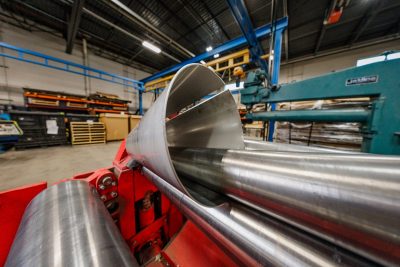
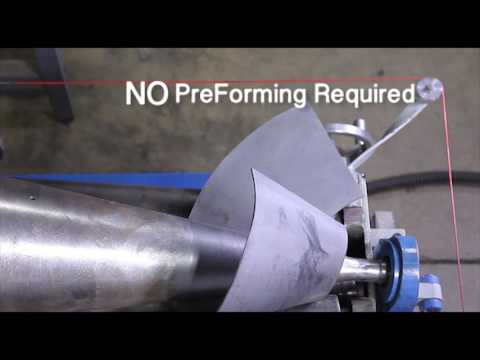
3. Rolling Without Deformation
The actual rolling process requires precision equipment and experienced operators. The goal is to gradually form the plate into a conical shape without:
- Wrinkling
- Flat spots
- Excess thinning
- Ovalization
Maintaining dimensional integrity throughout the rolling process is one of the biggest technical challenges. Controlled pressure and incremental forming ensure uniform curvature and structural consistency.
4. Seam Welding and Finishing
Once formed, the seam is welded to create a complete cone. Depending on application requirements, this may involve TIG, MIG, or other specialized welding processes.
After welding, the cone may undergo:
- Planishing and finishing
- Non-destructive testing
- Dimensional inspection
- Pressure testing
Quality control at this stage ensures the cone performs reliably under real-world conditions.
Real-World Applications
Custom cones often serve in demanding environments. Some real-world examples could be:
- In aerospace systems, they help manage flow while maintaining structural strength.
- In water treatment systems, they help fluid transitions.
- In food processing, they must meet sanitary standards while maintaining structural integrity.
In each case, precision fabrication directly impacts system performance and compliance.
Why Experience Matters
Cone rolling combines mathematics, metallurgy, and hands-on craftsmanship. Achieving consistent results requires not only advanced equipment but also deep experience with material behavior and forming techniques.
When cones are fabricated correctly, they become seamless components within larger assemblies, delivering performance without compromise.
If you are looking for a custom welded cone, please contact us today for a custom quote.


