

Why Do Flat Spots Form During Cone Rolling?
When you picture a finished metal cone, you probably imagine a smooth, continuous taper from one diameter to another. But achieving that shape isn’t always as straightforward as running a sheet of metal through a set of rollers. One of the challenges manufacturers encounter during cone rolling is the formation of flat spots, particularly near the edges where the material eventually comes together to form a seam.
These flat sections may seem minor, but they can affect the cone’s roundness, weld alignment, and ability to fit into a major assembly. So, why do flat spots form during cone rolling, and what does it take to achieve a consistent, properly formed cone?
What Are Flat Spots in Cone Rolling?
Flat spots are sections of a rolled metal component that have not achieved the intended curvature. Rather than following the smooth, rounded profile of the cone, these areas remain relatively straight or less curved than the surrounding material. In cone rolling, flat spots commonly occur near the leading and trailing edges of the metal sheet. These are the edges that eventually meet to form the cone’s longitudinal seam.
When those edges aren’t formed to the appropriate curvature, the finished cone may have a noticeable flat area or an abrupt change in shape near the seam. The challenge becomes especially important when the cone needs to maintain specific diameters, roundness, or alignment with adjoining components.
Why Do Flat Spots Form?
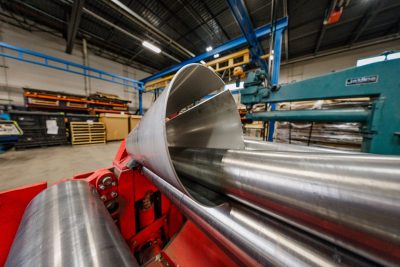
The answer has a lot to do with how rolling equipment works. During cone rolling, a flat metal pattern passes between rollers that apply pressure to gradually roll the material into its required shape. However, the rollers need enough material to grip and apply the necessary rolling or forming force.
As a result, the very beginning and end of the sheet may not experience the same rolling or forming action as the material passing through the main forming area. This can leave sections near the edges that haven’t developed the intended curvature. It’s a natural consideration in the rolling process, not necessarily an indication that something has gone wrong. The important distinction is whether those flat sections are accounted for during manufacturing.
Why Are Flat Spots More Challenging With Metal Cones?
Rolling a cylinder and rolling a cone are not quite the same. With a cylinder, the intended radius remains consistent along its length. With a cone, the radius changes from the major opening to the minor opening. That difference introduces an additional challenge.
During cone rolling, the major end of the material must follow a longer curved path than the minor end. The forming process needs to accommodate those different radii while maintaining the cone’s intended taper. Now consider what happens near the seam.
If the edges haven’t been formed correctly, the amount of curvature needed at the minor end differs from what is needed at the major end. A flat section may therefore affect the shape and alignment of the finished cone differently along the length of the seam.
This is one reason cone rolling requires careful attention to how the material is positioned, formed, and brought together.
What Problems Can Flat Spots Cause?
A flat spot isn’t simply a cosmetic concern. Depending on the application and dimensional requirements, it can create complications during fabrication and assembly.
Poor Roundness
A finished cone needs to maintain its specified geometry, including the dimensions of its major and minor openings. Flat spots can interrupt the intended curvature and contribute to an out-of-round condition. This becomes especially important when the cone must connect to circular tubing, piping, tanks, or other fabricated components.
Difficulty Aligning the Weld Seam
After rolling, the edges of the metal are brought together to form the cone’s longitudinal seam. If those edges remain too flat, they may not align with the intended profile of the finished component. This can make weld preparation and fit-up more challenging and may require additional forming or adjustment before welding.
Problems During Assembly
A custom metal cone is often just one component within a major piece of equipment. If its shape differs from the specified geometry, the cone may not fit properly with adjoining components. Even relatively small variations can matter when an assembly requires accurate alignment or consistent contact between mating surfaces.
Additional Manufacturing Time
When flat spots exceed acceptable limits, additional work may be necessary to correct the component. Depending on the material, geometry, and manufacturing approach, this can involve further forming, adjustment, or other corrective operations. Addressing potential flat spots during the initial manufacturing process can help minimize unnecessary rework.
How Do Manufacturers Reduce Flat Spots During Cone Rolling?
Because flat spots are a known challenge in rolling, manufacturers can plan for them before the finished cone takes shape.
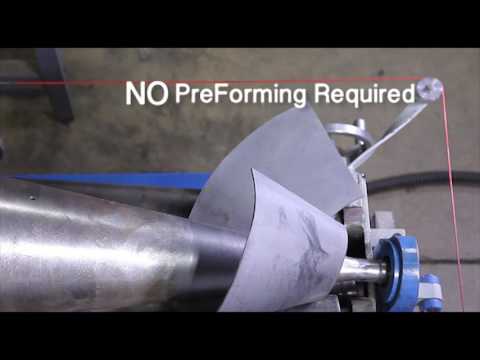
One common approach is pre-bending. Pre-bending involves forming the leading and trailing edges of the metal before completing the main rolling operation. This helps develop curvature in areas that may otherwise remain relatively straight because of the way the rolling equipment grips the material.
For cones, pre-bending requires particular attention because the desired radius changes between the major and minor ends. Other considerations may include the rolling equipment’s configuration, the material’s forming characteristics, and whether additional forming or trimming operations are appropriate.
The best approach depends on the specifications of the component and the equipment being used. Ultimately, the goal is to produce a smooth transition around the cone’s circumference while maintaining the required dimensions.
Why Flat Spots Matter in Precision Cone Fabrication
A metal cone may appear simple, but its finished shape depends on how accurately the material is formed throughout the rolling process. Flat spots are a good example of why the details matter.
A component can have the correct material, thickness, and overall dimensions on paper, yet still require careful forming to achieve the intended curvature near its seam. For manufacturers producing custom cones, understanding these challenges before fabrication begins can help improve consistency, support accurate weld fit-up, and reduce avoidable production issues.
Custom Cone Rolling at Tech-Weld
At Tech-Weld, custom metal cone fabrication is one of our specialized manufacturing capabilities. We produce concentric and eccentric cones for customers across a variety of industrial applications, with additional capabilities in precision welding and custom metal fabrication.
Whether a project involves a straightforward tapered component or a more demanding custom design, attention to forming accuracy is an important part of producing a cone that meets its specifications.
Need a custom metal cone manufactured for your next project? Contact Tech-Weld to discuss your requirements and request a quote.


