

From Flat Sheet to Finished Cone
A finished metal cone may look straightforward, but manufacturing one accurately requires careful planning at every stage.
Before a piece of metal ever reaches the rolling equipment, manufacturers have to account for the cone’s final dimensions, material, thickness, geometry and tolerances. The shape that begins as a flat piece of material must ultimately form into a precise three-dimensional component that can be welded and incorporated into a larger assembly.
So, how does that happen? Here is a closer look at the custom metal cone fabrication process, from flat material to finished component.
Step 1: Start With the Finished Cone Specifications
Every custom cone begins with the requirements of the finished part.
Depending on the application, those specifications may include:
- Major diameter
- Minor diameter
- Overall height or length
- Material
- Material thickness
- Required tolerances
- Welding specifications
- Quantity
- Additional fabrication or inspection requirements
These details determine how the cone will need to be developed, cut, formed and welded.
This is also why providing an accurate drawing or detailed specifications at the beginning of a project is so important. Small changes in geometry can affect the shape of the flat pattern and the way the material needs to be formed.
Step 2: Develop the Flat Pattern
Here is where the process gets interesting.
You cannot simply cut a rectangle from a sheet of metal and roll it into a precise cone. The material must first be developed into a flat pattern that accounts for the dimensions and geometry of the finished part.
When that flat pattern is formed, its edges need to come together to create the specified cone.
Accurate pattern development helps set the stage for everything that follows.
Step 3: Cut the Material
Once the flat pattern has been established, it can be cut from the selected material.
Precision cutting allows manufacturers to create the required profile before the material moves into forming. Depending on the material, thickness and specifications of the project, different cutting methods may be appropriate.
Accuracy at this stage matters. The cut edges will eventually become part of the finished cone and may need to align for welding after forming.
Efficient cutting and material layout can also help minimize unnecessary material waste, particularly when multiple components are being produced.
Step 4: Roll the Flat Pattern Into a Cone
Now the flat piece finally starts looking like the finished product.
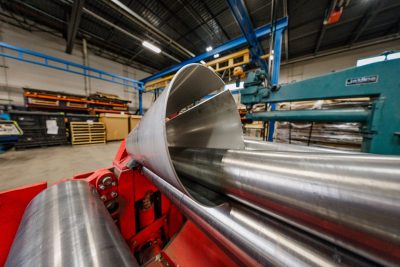
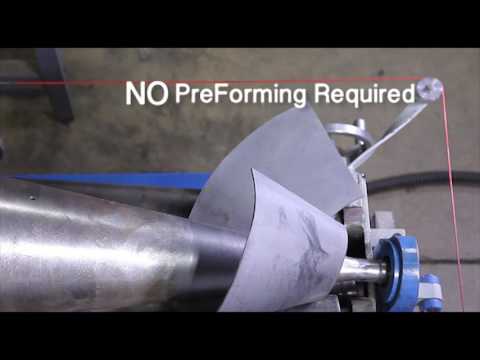
Using specialized rolling equipment, the cut pattern is gradually formed into its three-dimensional cone shape.
This is not necessarily a one-pass operation. The material may require controlled adjustments throughout the rolling process to achieve the specified diameters and geometry.
Material thickness, alloy, and cone angle can all affect how the component behaves while it is being formed.
Experienced operators must understand both the equipment and the material to produce a consistent finished shape without introducing unnecessary distortion.
Step 5: Weld the Seam
Once the cone has been formed to the required geometry, the edges are brought together and the longitudinal seam can be welded.
The appropriate welding process depends on the material and project specifications. For applications requiring high-quality precision welds, TIG welding may be used to create a clean, controlled seam.
Welding is particularly important because excessive heat or poor control can introduce distortion into a component that has already been carefully formed.
The goal is not simply to close the seam. The finished weld must meet the requirements of the part while helping preserve the cone’s intended geometry.
Step 6: Inspect the Finished Cone
Before a custom cone is ready to leave the shop or move into the next stage of an assembly, it needs to be checked against the project’s requirements.
Inspection may include verification of dimensions, diameters, geometry, weld quality and other customer-specified criteria.
For components manufactured for highly regulated industries, additional documentation, inspection or quality requirements may also apply.
This final step helps ensure that the cone delivered is the cone specified on the drawing.
More Than Just Cone Rolling
One of the advantages of working with a full-service metal fabricator is that these processes do not necessarily need to happen at separate facilities.
At Tech-Weld, custom fabrication capabilities include precision cutting, forming, cone rolling, welding and inspection. That means a component can move through multiple stages of production with one manufacturing partner.
For OEMs and manufacturers, consolidating fabrication processes can simplify communication, reduce unnecessary handling between suppliers and create greater continuity throughout production.
Custom Metal Cone Fabrication at Tech-Weld
Tech-Weld has decades of experience manufacturing precision welded components, including custom cones, tubes, tanks and weldments for demanding applications.
From straightforward rolled components to complex assemblies manufactured from specialty materials, our team works with customers to produce parts according to their specific drawings and requirements.
Have a custom cone or fabricated component you need manufactured?
Contact Tech-Weld to discuss your project or request a quote for custom cone rolling and fabrication services.


